
You don’t have to know everything before you start. You just have to stop throwing away what you learned.
Chad Fowler wrote that at the end of an essay, The Spec Can Come Later, which argues that we mostly discover what we want by building it, so the specification can come later [1]. The essay belongs to The Phoenix Architecture, his publication about what AI-assisted coding does to the way software is made.
To me the sentence is about something else as well. It is about how organisations think, and about how much of what they learn sits with the people who were in the room when it was discussed. People move on, for one reason or another, and what they carried moves with them.
That is the question I have been living with, first in my own research and writing and since 2026 in a company of one, where much of the thinking develops between me and the different AI services I use. Put simply: what could we take on together if we could keep building on everything we had already worked through?
This is the first article in a short series about what I have learnt from trying to answer that question in practice. The point of view is simple to state. The capability of the individual services is the part I can leave to the people who build them. The part that is mine to get right is how capable contributors, people and AI, build on each other’s work over time, and who decides.
This article is about where the question came from. The ones that follow are about what happened when I tried to answer it: what it took to keep a shared memory trustworthy, and what a build that passed its tests taught me about the difference between a check and a usable result.
Before the company
None of this started with a company. I started out, years ago, using these services as glorified Google search fields. Instead of searching, I asked, and I asked very direct and specific questions, hoping that the response would be final. The services have developed since, and so has my use of them, but that is where it began. The questions came out of my own research and writing, and I wanted that thinking tested.
Then the questions grew. They turned into stories and projects, and simply asking was not enough anymore. Early on I started using more than one service, and I noticed something that has shaped my thinking since: they seldom agreed with each other in full. Together, and iteratively, we came closer to something that worked, and I found the conversation among us often more rewarding than the result itself.
There was a cost to it that I did not enjoy. Each conversation grew until there was no more room, and I started a new one or broke a piece out into another. The conversations had no sense of past, present, and future, so that sense had to be mine. I was the single point of contact for everything. I carried the context from one conversation to the next, explained how the work had developed, handed out the tasks, and kept in my head which conversation knew what. Overhead. Administration. Cumbersome, and not fun. And whatever we worked out stayed inside the tool where we had worked it out, unless I asked for a summary and carried it over myself.
It all worked, for tasks. Not for projects, not the way I was working then.
The distinction I kept returning to was depth and breadth. We were building vertically, deeper inside each prompt and each conversation, and not horizontally, across the work. The vertical I could leave to the people building the services, whose models and capabilities keep evolving. The horizontal was mine to solve: how an increasing number of capable contributors, AI today and people too, could build on each other’s work rather than on my memory of it. Because the more capable each of them became, the clearer it was that I was operating in other types of silos. Deeper and better silos, but silos.
A book read for entirely different reasons
The book that came to mind had stayed with me for entirely different reasons: Team of Teams [2]. Stan McChrystal, the retired US Army general whose career included leading the Joint Special Operations Command in Iraq, describes an organisation of extraordinarily capable teams that still had to change how it worked to keep up with a faster and more connected world. His answer rests on two ideas. Shared consciousness, a common understanding of the situation across the whole organisation. Empowered execution, decisions taken by the people closest to the problem.
What stayed with me is simple. In a world where things happen fast, sharing, and finding the means to share, is critical. The people closest to a problem know the situation best, and they are the ones to be supported.
The book pictures the journey in three arrangements. Command, where the connections run up and down a hierarchy. Command of teams, where small teams are tightly connected inside themselves but still sit in a rigid structure. Team of teams, where the connections run across the teams as well, until the teams relate to each other the way the people inside a good team do.
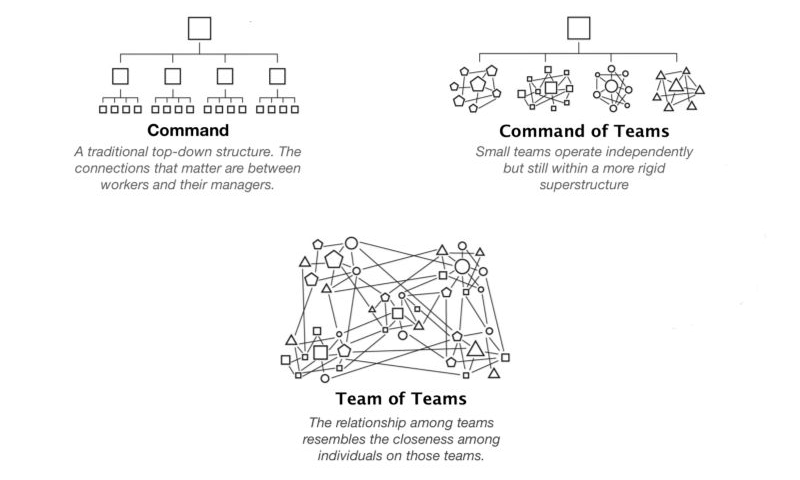
I looked at that picture and saw how I was working with AI. I was the commander. I issued instructions one prompt at a time to contributors who could not see each other’s work. Projects and shared resources had moved me to the second arrangement, well connected within a service, with me still the only link between them. What I wanted was the third.
What if we applied that to how we work with AI?
The memory I wanted
The idea that followed was a collective memory, rather than the siloed memory of each member. What if every conversation, every project, every agent, and every human contributed to one memory that builds on what was made last? Where a piece of work can be lifted out and still make sense. Where the memory grows, matures, and evolves. Where I never have to say again what I said five minutes ago in another context, because every input adds to the context. Where nothing is lost, and we do not repeat ourselves depending on who happens to be in the room.
I think this question is bigger than one person’s working habits. Think of what an organisation remembers. Its memory lives in Confluence and PowerPoint, in Miro boards and Word documents. The artefacts are there. The reasoning behind them is mostly gone: which alternatives were considered, who disagreed and why, and what changed the decision. It sits with the people who were there. If you have ever inherited a plan without its reasons, you know the feeling. And now we have capabilities that can help us make sense of everything we have collected, if we keep it in a form they can read.
Two needs followed before any tool did. The memory has to be ours. If it lives inside one supplier it goes wherever that service goes, and I want it to come with us when the tools change, with room for more contributors, from other providers and in time other people.
And it has to carry its history. I want to see what was decided, the basis for it, and what was later revised, so that when something looks wrong we can go back to an earlier version and understand how we got here.
Only then did the solution matter, and it turned out to be unglamorous: plain text files that we own, with the history of the central working record kept, and an arrangement in which a conversation reads that record before it starts work and writes back to it when it is done. Nothing lost is the ambition. Keeping it true is work, and that work is the next article.
I am not alone in building along these lines. Others are keeping memory for their agents in local, versioned files too, and there is a lot to learn from them [3]. What I can add is the record of running a real company this way: the choices, the disagreements, and the corrections.
A commercial version of the same idea
There is a commercial version of this idea too, and it is worth seeing where it differs from mine. In a recent essay for Andreessen Horowitz, David Haber describes agents that run for weeks or months inside a high-value customer journey, a legal case for instance, saving and retrieving context as they go, dispatching sub-agents, and keeping a complete record, with drafts going to a person for review before they are final [4]. His thesis is about business models: vendors that can carry the whole relay can price on the outcomes they help create.
Mine is a different question, and I think it comes first. How does an organisation keep hold of its own reasoning across contributors, providers, and time, whoever runs the agents? The two meet in one requirement. Context has to remain usable over time. Haber’s essay says what that could be worth. The rest of this series is about what it takes.
Where the judgement lives
I said that I started out asking direct questions and hoping for a final answer. What I value now is close to the opposite. The services I use seldom agree in full, and when they disagree in writing, with their reasons, I have something to examine. Which assumption produced each answer? What evidence is behind it? Does the disagreement reveal something missing from my own question? Agreement would tell me much less. And when the arguments are kept with their reasons, we do not start from zero the next time the question comes up.
The assumption that people and AI necessarily perform better together deserves the same scrutiny. A 2024 review of 106 experiments published between 2020 and mid-2023 found that people and AI together performed better, on average, than people alone, and worse than whichever of the two was better on its own [5]. The review concerns earlier systems and does not establish how an arrangement like mine performs, but the caution stands. Putting capable contributors together guarantees nothing. Fowler makes the same point about code. Discovering things by building is not the same as deciding which of them to keep, and that decision stays with a person [1].
That someone is a human. We live with the consequences of our decisions, something an AI never has to face, and that is where judgement has to reside. In my company the services research, propose, challenge, and check each other, and the decisions that carry consequences are mine.
Which brings me to what I think is most undervalued in all of this. The services have limits of their own, and a good question does not remove them. But I am convinced that an AI is never better than the questions we ask of it, and the questions we ask of its answers. Too many people use it as a content generator. Its real capability is inquiry: to pursue a question across a breadth of material we could never have searched, to ask for advice, to be challenged, and to open a line of thought and follow it. In my experience what limits us most is our own ability to stay curious. Unless you are curious and good at asking questions, your answers will suffer.
The research on how we understand other people points the same way. In a programme of 25 experiments, imagining another person’s perspective proved an unreliable way to understand them. Obtaining their perspective, by asking, helped [6].
Whether practice at questioning machines changes how we question people is something I would like to see answered. Two preregistered experiments found that how programmed partners behaved in a game carried over, immediately afterwards, into how people cooperated with other humans [7]. Those were simple bots and games, not conversations with the assistants we use today. They show that behaviour can carry over in the moment. They do not show lasting transfer, or that everyday use of these assistants changes how we question people.
What if we not only asked better questions of our AI collaborators, but opened up the conversations inside our organisations and started listening to everyone in them? What could become possible if more of what people know became available to the people who need it?
What this enables
So, to the question I started with. What could we take on together if we could keep building on everything we had already worked through?
With an open mind, and these collaborators to pitch in, I believe the opportunities are endless. Having them at hand is like having the people with the broadest and deepest experience and competence in the room, with the difference that what we work out does not have to be lost when the conversation ends. The company is where I test that now, on real work. Some of the tests have gone wrong in instructive ways, and those are the stories that follow.
The route from here
Each article in this series stands on its own, and each is built on something that actually happened.
The next one is about the memory itself. A memory that keeps the reasoning can also keep objectives that no longer apply. I will tell what happened when objectives I had already replaced were still presented as current, how the error was found, and what it takes to keep a shared memory trustworthy rather than merely large. It is also where I will go into how the memory is built, and what I am learning from others who are building along similar lines.
After that, the difference between a test and a usable result. A piece of software passed its technical checks and independent reviews, and then failed the human walkthrough that was required before it could be accepted. The documentation existed. What was missing was the translation from one ordinary human scenario into screens a person could understand. What the technical checks established, and what the human walkthrough exposed, is the subject of that article.
More will follow if the work earns them.
Fowler was writing about code. I think his sentence is true of companies, and of the people in them. Where does the reasoning behind your last significant decision live, and could someone examine it without you in the room? If you have an arrangement that works, or an objection this story should answer, I would like to hear it.
References
[1] Fowler, C. (2026, Sep 28). The Spec Can Come Later. The Phoenix Architecture
[2] McChrystal, S., Collins, T., Silverman, D., and Fussell, C. (2015). Team of Teams: New Rules of Engagement for a Complex World. Portfolio
[3] Letta. (2026, Feb 12). Introducing Context Repositories: Git-based Memory for Coding Agents
[4] Haber, D. (2026, Oct 14). Winning the Relay Race: Long-Running Agents in High-Value Customer Journeys. Andreessen Horowitz
[5] Vaccaro, M., Almaatouq, A., and Malone, T. (2024). When combinations of humans and AI are useful: A systematic review and meta-analysis. Nature Human Behaviour, 8, 2293–2303
[6] Eyal, T., Steffel, M., and Epley, N. (2018). Perspective mistaking: Accurately understanding the mind of another requires getting perspective, not taking perspective. Journal of Personality and Social Psychology, 114(4), 547–571
[7] Harrell, A., and Traeger, M. (2025). Evidence of spillovers from (non)cooperative human–bot to human–human interactions. iScience, 28(8), 113006
Originally published on LinkedIn on October 16, 2026. Join the discussion →